The Paperwork Revolution: AI Is Transforming the Boring Parts of Policing
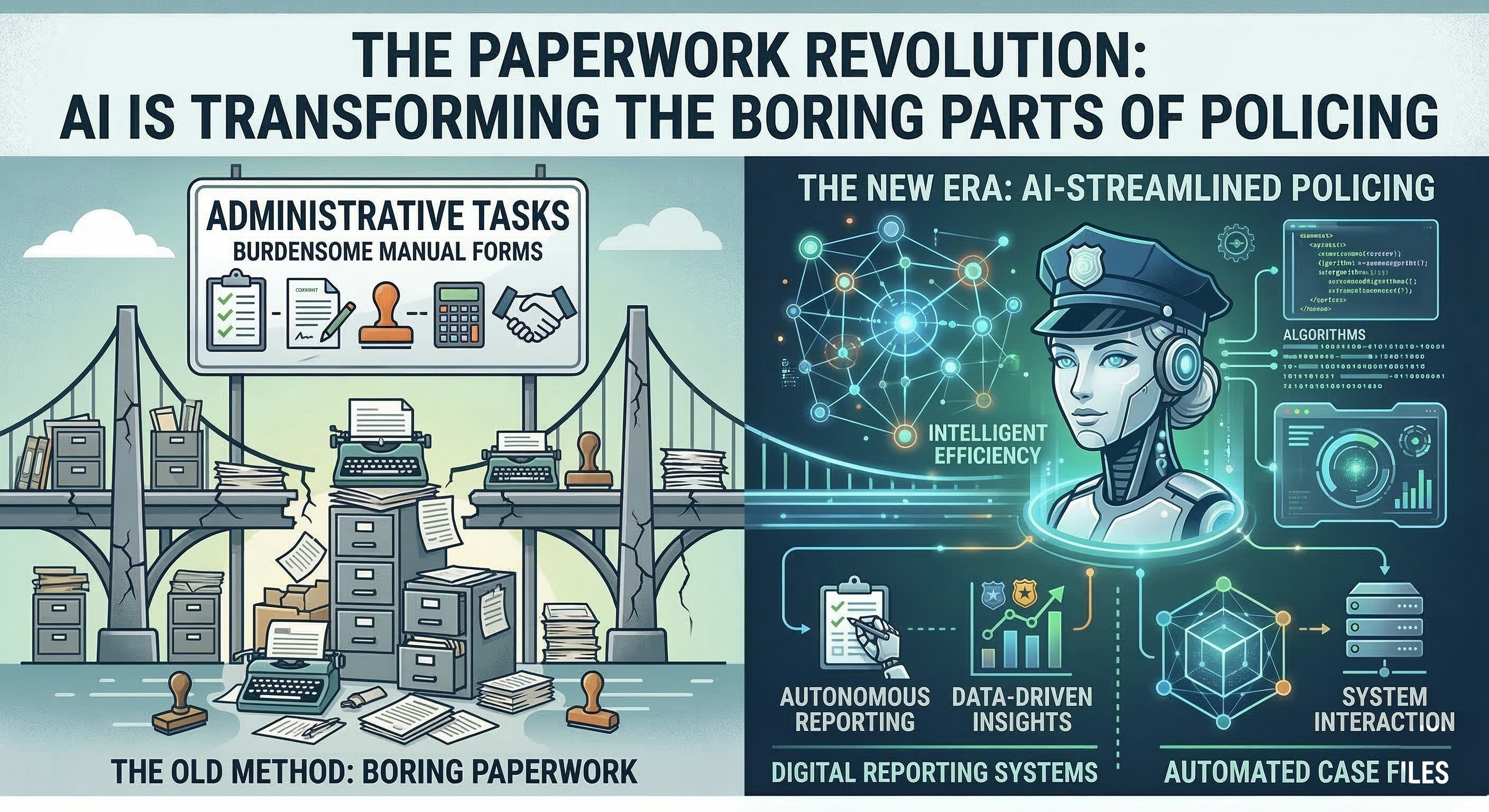
Automatic License Plate Readers (APLR) and Facial recognition technology are central to many conversations about AI in policing. They shouldn’t be. The most consequential AI transformation in law enforcement is happening in the parts of the job nobody wants to talk about: the paperwork, the administration, the compliance monitoring, the after-action reviews, the audits.
The Report-Writing Revolution
Axon’s Draft One launched with a simple premise: let AI draft police reports from body camera audio. The results have been difficult to ignore. Officers report an 82% reduction in report-writing time. The system has generated over 100,000 reports and counting.
This isn’t a marginal efficiency gain. Patrol officers typically spend one to two hours per shift on documentation. In a profession facing an unprecedented staffing crisis, the Police Executive Research Forum estimates 86-92% of departments are understaffed. Draft One isn’t an optimization. It’s a survival mechanism.
But the governance questions are immediate. California recognized this early: SB 524 now requires that every page of an AI-generated police report carry a disclosure label. The EFF celebrated the bill as a victory for transparency. It’s a reasonable first step, but disclosure alone doesn’t address accuracy, bias in audio transcription, or what happens when an officer signs off on a report they didn’t write.
The Compliance Monitor
If Draft One changes how reports get written, Truleo changes how officers get evaluated. The platform uses AI to analyze body-worn camera audio, not video, for professionalism, de-escalation, and procedural compliance. It monitors 100% of interactions. The alternative? Manual review of less than 1% of footage, usually triggered by complaints.
The evidence here is striking. A randomized controlled trial published in Criminology by Adams et al. found that AI-driven feedback on BWC interactions was more effective at changing officer behavior than classroom training. In Paterson, New Jersey, the department reported a 50% reduction in unprofessional language following the deployment of AI-based monitoring.
This is a genuinely different proposition from public surveillance. It’s police surveillance — by the police.
The Governance Paradox
The Colorado AI Act establishes a duty-of-care framework for high-risk AI deployers, requiring impact assessments, ongoing monitoring, and consumer notification. A GAO report on AI in law enforcement has further pushed for federal standards around transparency and accountability.
But here’s where it gets uncomfortable for some: who governs the AI that grades officer professionalism? When an algorithm decides that an officer’s tone was “unprofessional,” what’s the appeals process? When AI-generated performance metrics influence promotions, discipline, or terminations, the system isn’t just assisting policing; it’s defining what good policing looks like. Fortunately, departments across the nation already have checks-and-balances systems in place that address this concern. These departments report to other non-law-enforcement state government entities that help keep these processes honest and transparent.
The Boring Future
The flashy AI debates — such as automatic license plate reader (ALPR) tracking, facial recognition, predictive policing, and autonomous drones — will continue to dominate LE discussions on Artificial Intelligence. But the transformation that touches every officer on every shift is happening in administrative support tools, compliance monitors, and backend AI-enhanced features to already existing technologies.
This boring revolution has solid benefits but also poses governance challenges. It also has the potential to reshape police culture from the inside out — not through training mandates or policy reforms, but through the quiet and at times loud evolution and advances in technology and Artificial Intelligence.